
Simple solutions to complex problems: Outlaw private schools?
A brief break from the omnishambles of the Trump-era

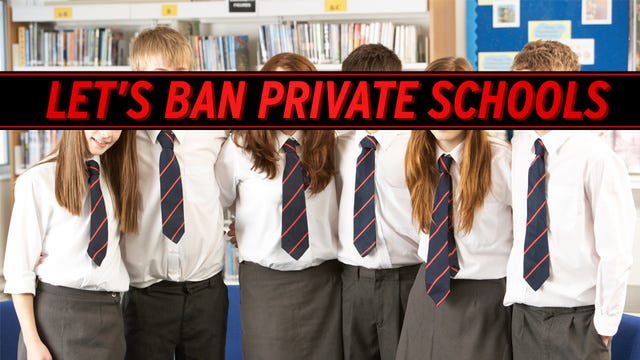
In the world of polite discourse, few subjects are more inviting than debating someone who proposes a “simple solution” to a complex problem. More often than not, these easy answers come from those on the right. But sometimes they originate with equal certitude from the idealistic left.
In an effort to take a break from the never-ending dystopia of Trumperama, I sifted through some of my old bookmarks and came across a 2012 piece from the now-defunct Gawker, which J.D. Vance’s mentor, tech bro Peter Thiel, put out of business. Headlined “There’s a Simple Solution to the Public Schools Crisis,” the piece was paired with the image you see above. You get the idea. If you give wealthy people no alternative, they’ll have to enroll their children in public schools. There is a certain logic to this which I will get to later, so bear with me.
The column also spawned several lively Reddit threads, one of which can be found here.
Disclosure: I started my career as an English and theatre teacher in private schools and attended them earlier as a student and, while my two children are products of our local public schools, my expertise in public schools is limited. Perhaps as a result, it’s hard for me to tell whether the author is serious or whether he’s just engaging in a polemical exercise. Let’s assume for the moment that it’s neither a performative display nor satire. After all, the author, John Cook, is now deputy investigations editor at the Wall Street Journal, so I think it’s fair to assume that he’s a serious person.
Cook wrote the piece during a contentious and ongoing teacher strike in Chicago, where approximately 26,000 faculty and staff walked away from their jobs, resulting in a seven-day shutdown of the city’s schools, a vast system serving some 350,000 students.
Cook correctly points out that the city’s wealthy elite, including then-Mayor Rahm Emanuel, sent their kids to private schools, and so these upper-income residents were scarcely inconvenienced by the shutdown. Likewise, Emanuel’s former boss, President Barack Obama, had sent his daughters Sasha and Malia to the fancy Sidwell Friends School in Washington.
So Cook is correct that wealthy urbanites don’t have much of a stake in the quality of the public schools in their communities, and so consequently those schools remain “terrible,” as Cook described Chicago’s. So what’s the best solution?
There is one simple step that would go a long way toward resolving many of those issues: Make all schools public schools.
There are a number of problems with this approach, which Cook acknowledges would be “a radical and highly disruptive step.” But Cook argues that the idea of banning private schools — which in England are perversely called “public schools” (go figure) — has been in serious debate in the United Kingdom for decades.
In the United States, the federal government would have to step in and, in effect, nationalize the nation’s independent schools. Or individual states could do the same. This would involve not only the seizure of private property belonging to nonprofits, but the property of independent school systems belonging to churches and religious institutions, an ownership block making up at least 75% of the nearly 30,000 private schools in the U.S.

Religious schools would no doubt challenge the seizures on constitutional grounds, and they would have a powerful case. The First Amendment’s Free Exercise Clause prevents the government from interfering with or prohibiting an individual’s right to practice their faith freely so long as the practice does not run afoul of “public morals” or a “compelling” governmental interest.
Those who want to ban private schools would have to hang their hats on the “compelling government interest” language, but it’s hard to believe that the U.S. Supreme Court would rule in their favor. And I don’t see how eminent domain precedent would apply either because seizing all private schools would be a sweeping move far exceeding the scope of, say, taking privately-owned land for a park or a new city hall.
I’ve long argued that school choice would make public schools better because they would have to compete against their independent competitors, which typically pay their teachers less but get better results. That said, so-called private-school “voucher” programs are not perfect.
For example, I firmly believe any voucher program should be means-tested and delivered on a sliding scale. School choice should not be a vehicle for wealthy people to get taxpayers to pay for their kids’ private schooling.
It would behoove public schools to occasionally be more responsive to market demands. As a case in point, look no further than the way some public school systems in the United States responded to the COVID-19 pandemic.
Public school districts with strong teachers unions — mostly those in the northeastern U.S. and on the west coast — were slow to reopen fully with in-person learning, even though there was never any real evidence that schools were super-spreader environments.
For example, the board of education in the Massachusetts public school district I was covering at the time started off the 2020 school year in September with a remote learning program, with an announced transition to half the students coming in for in-person learning during the first half of the week, with the other 50% coming to campus for the second half of the week.
But under pressure from the powerful teachers union, the district decided against that arrangement and began the year in remote-learning-only mode, which is ineffective for most students, especially those with special needs. This was good for the teachers but bad for the students who have no union to look out for their interests.
In contrast, private schools in the area resumed hybrid and in-person learning much quicker. After all, if private schools stayed with remote-learning for long periods of time, parents could quite reasonably demand tuition refunds that could result in a budget crisis with faculty lay-offs. For obvious reasons, public school teachers had no such fears. Parents and taxpayers would just have to take it on the chin, even as their children suffer.
It’s also worth looking at other nations around the world to determine how many allow private education. With the exception of North Korea and Cuba (virtually the last bastions of totalitarian communist rule), all nations allow some form of private schooling, even China. These nations vary from light regulation (as is the case here in the U.S., where private schools have 10% of the market) to tolerance of private education, but with prohibitions on for-profit schools (Finland, China).
Finally, Cook rolled out this old chestnut:
Billionaire wise hobbit Warren Buffet once told school reformer Michelle Rhee that the easiest way to fix schools was to “make private schools illegal and assign every child to a public school by random lottery.”
Of course, you could say that about a lot of things. If rich people were forced by law to take the subway to work, public transportation would surely improve by leaps and bounds. If the wealthy were compelled to dine at soup kitchens, the less fortunate would eat better.
Americans have a longstanding aversion to the government (federal or state) telling them what they can and cannot do even if they’re not actively harming anyone else. That is not likely to change anytime soon.
Thanks Lizzie. Let me address your last point. When the pandemic first struck, workers deemed "essential": healthcare, grocery, pharmacy, law enforcement, first responders et al -- were needed and could not stay home unless they could prove individually that they were sick or especially vulnerable. Are teachers essential? We both know the answer to that question. I'd like to think I was.
Great piece! Private schools should not receive public funding, in which case they should be able to coexist with public schools. But I do understand a big problem is that wealthier kids can be walled off from their less affluent peers. It becomes a form of class-based segregation. I know the idea is that these schools are an alternative in states with subpar education systems. In which case the latter need to be reformed. I also realize the lack of subsidy narrows the pool of who can enroll their kids, however people making a mean or average wage typically cannot bridge the difference between the tuition and the voucher. Especially with the cost of childcare, healthcare and higher education. Only wealthier people can afford to and naturally will seek the subsidy if it exists.
As for Covid, the problem with school kids was they did not live in a perfect vacuum. They could be transmitters to vulnerable members of society (sick or compromised parents, grandparents, teachers). Before vaccines were available, I was ok with the distancing. People were dying. After vaccines became available, I agree the resumption of in person learning probably should have happened sooner. But trying to Monday quarterback a novel once in century public health crisis always makes it seem like there was intentional neglect rather than acknowledging the difficulty of trying to manage a deadly virus with little to go on. As a country we never acknowledge that a million Americans died. As if doing so would make all the political finger pointing seem cruel and petty and ridiculous. We did the best we could. Let's learn what we can and be better prepared the next time. That kind of sensibility is all but dead.